Crisis Prevention Policy

For immediate danger, medical emergency, overdose, seizure, severe bleeding, unconsciousness, active violence, weapon concern, or life-threatening emergency, call 911.
 
For immediate behavioral health crisis support, call or text 988.
 
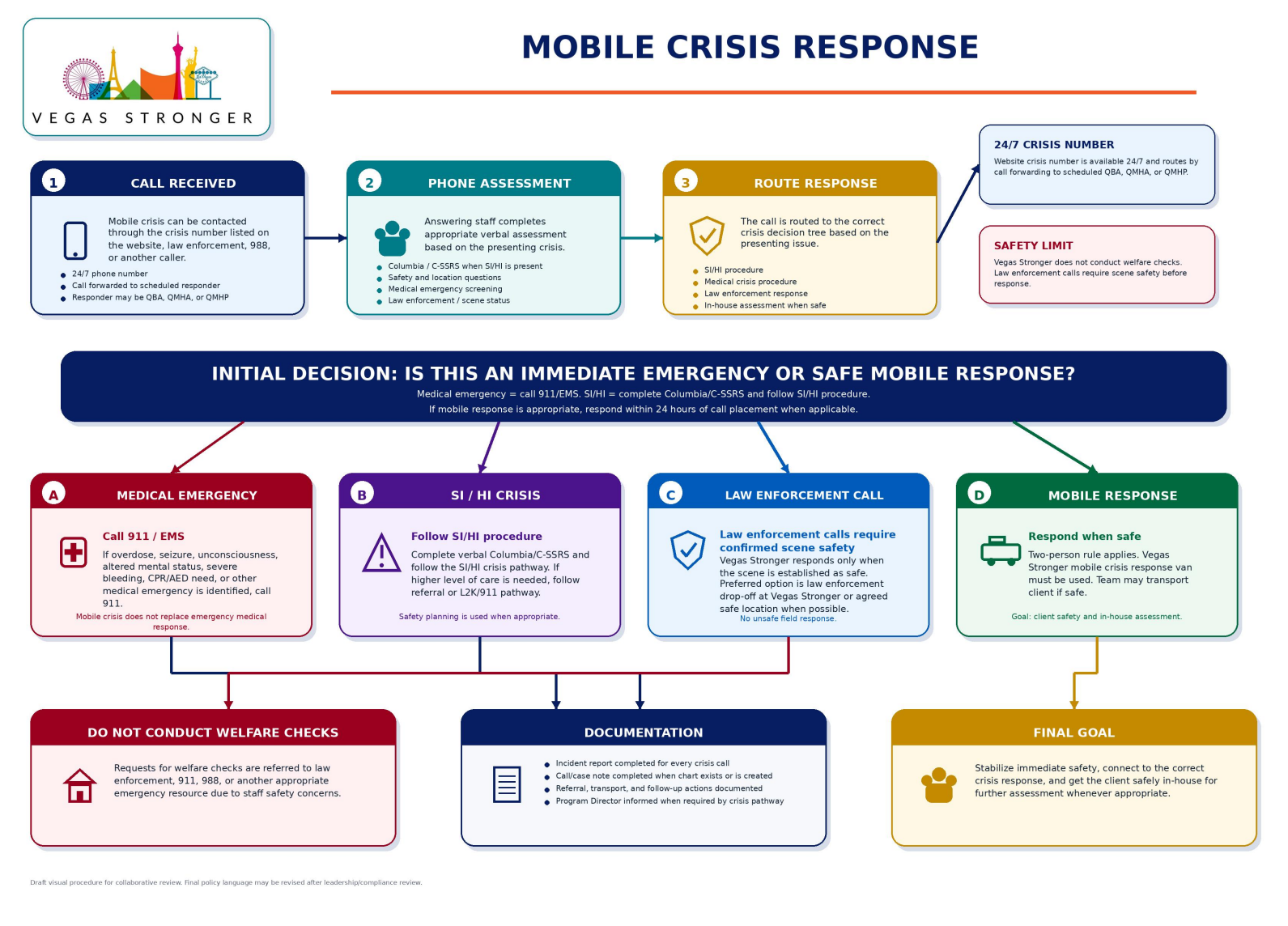
Vegas Stronger’s crisis number is available 24/7 and routes to scheduled crisis response staff. Mobile crisis response may occur when safe and appropriate. Vegas Stronger does not conduct welfare checks and only responds to law enforcement-related calls when the scene is confirmed safe.
Public Communication of Crisis Prevention, Response, and Postvention Services

Policy

Vegas Stronger shall maintain and communicate to the public clear information regarding its methods for providing a continuum of crisis prevention, crisis response, and postvention services. This communication shall be made available to clients, prospective clients, families, referral sources, community partners, law enforcement, hospitals, and the general public through accessible public-facing materials.

Vegas Stronger’s crisis continuum includes prevention activities, 24/7 crisis phone access, mobile crisis response when safe and appropriate, in-house assessment and safety planning, referral to higher level of care when indicated, coordination with emergency services, and follow-up after crisis events.

Vegas Stronger shall communicate that services are designed to support individuals experiencing behavioral health, substance use, psychiatric, medical, suicidal, homicidal, or safety-related crises. Vegas Stronger shall also communicate that 911 should be used for immediate medical emergencies, active violence, weapons, life-threatening emergencies, or situations where immediate public safety response is required.

Purpose

The purpose of this procedure is to ensure that the public understands how to access Vegas Stronger’s crisis prevention, response, and postvention services, including how to contact the agency, what types of crisis services may be provided, what limitations exist for staff safety, and how the agency coordinates follow-up after a crisis event.

Scope

This policy applies to all Vegas Stronger locations, programs, staff, public-facing communication materials, referral coordination processes, and crisis-related community outreach. This includes communication with current clients, prospective clients, families, community partners, law enforcement, hospitals, emergency departments, psychiatric facilities, 988, shelters, courts, housing providers, and other referral sources.

Public Communication Methods

Vegas Stronger shall communicate crisis service information to the public through one or more of the following methods:

  1. Vegas Stronger website, including the crisis phone number and basic crisis response information.
  2. Public-facing flyers, brochures, and referral materials.
  3. Client orientation materials, intake packets, handbooks, or program information sheets.
  4. Signage posted in client-accessible areas when appropriate.
  5. Communication with community partners, hospitals, shelters, courts, law enforcement, and referral sources.
  6. Staff communication during intake, assessment, treatment planning, discharge planning, and safety planning.
  7. Outreach and mobile crisis materials when applicable.
  8. Safety plans completed with clients, including crisis numbers and support resources.
  9. Public or partner education regarding how to contact Vegas Stronger during a behavioral health crisis.

Required Public Information

Public-facing crisis communication shall include, as applicable:

  1. How to contact Vegas Stronger for crisis support.
  2. That the crisis number is available 24/7 and is routed by call forwarding to scheduled QBA, QMHA, or QMHP staff.
  3. That staff may complete verbal crisis assessments, including Columbia/C-SSRS screening when suicidal or homicidal ideation is present.
  4. That mobile crisis response may occur when safe and appropriate.
  5. That mobile crisis response uses a two-person response rule and the Vegas Stronger mobile crisis response van.
  6. That Vegas Stronger may transport a client when safe and appropriate.
  7. That Vegas Stronger does not conduct welfare checks due to staff safety concerns.
  8. That law enforcement-related mobile responses require the scene to be established as safe before Vegas Stronger responds.
  9. That when possible, law enforcement drop-off at Vegas Stronger or another safe agreed location is preferred.
  10. That medical emergencies, overdose, seizures, altered mental status, severe bleeding, CPR/AED need, active violence, weapon concerns, or immediate danger require 911.
  11. That 988 is available for immediate behavioral health crisis support.
  12. That safety planning may include CAMS or Stanley-Brown safety planning methods.
  13. That Vegas Stronger provides follow-up and care coordination after crisis events when applicable.

Crisis Prevention Services

Vegas Stronger communicates and provides crisis prevention services intended to reduce risk before a crisis escalates. Prevention activities may include:

  1. Screening for suicidal ideation, homicidal ideation, behavioral health crisis, medical crisis, psychiatric symptoms, substance use concerns, and safety risks.
  2. Clinical assessment, case management, peer support, psychiatric services, primary care coordination, and referral to appropriate levels of care.
  3. Safety planning using CAMS or Stanley-Brown safety planning processes when indicated.
  4. Lethal means safety planning when suicidal or homicidal risk is present.
  5. Crisis resource education, including 988.
  6. NAMI Western Nevada Warmline information for adults age 18 and older.
  7. NAMI Western Nevada Teen Text Line information for youth and young adults age 24 and under.
  8. Treatment team review, care coordination, and referral to internal or external providers.
  9. Communication with outside providers when releases of information are in place.
  10. Culturally responsive planning that considers language, family/chosen family, cultural identity, spirituality, disability, housing status, legal involvement, transportation, phone access, and community supports.

Crisis Response Services

Vegas Stronger communicates and provides crisis response services based on the type and severity of crisis. Crisis response may include:

  1. Verbal assessment by scheduled crisis staff, QBA, QMHA, QMHP, counselor, therapist, or other qualified staff depending on setting and crisis type.
  2. Columbia/C-SSRS screening when suicidal or homicidal ideation is reported or observed.
  3. Safety planning when the client has passive suicidal/homicidal ideation or ideation without plan or intent.
  4. Higher level of care referral when suicidal or homicidal ideation includes plan and intent, or when the client cannot remain safe.
  5. QMHP consultation and L2K process when involuntary hospitalization may be required.
  6. 911 activation when emergency response is required.
  7. Medical crisis response, including first aid, CPR, AED retrieval, Narcan administration, seizure response, and 911 when indicated.
  8. Psychiatric crisis response, including de-escalation, safe location, consultation with QMHP or psychiatric provider when available, and referral to higher level of care when indicated.
  9. Combative or aggressive client response using de-escalation, separation from others when safe, two-staff response, hands-off approach, and 911 for stated or acted violence.
  10. Mobile crisis response within 24 hours of call placement when safe, appropriate, and applicable.
  11. Coordination with hospitals, psychiatric facilities, crisis stabilization resources, law enforcement, 988, EMS, and other emergency or referral sources.

Mobile Crisis Response Communication

Vegas Stronger shall communicate the following mobile crisis response information to the public and referral partners:

  1. The mobile crisis number is available 24/7.
  2. Calls are routed by call forwarding to scheduled QBA, QMHA, or QMHP staff.
  3. Answering staff conduct appropriate verbal screening and assessment based on the crisis type.
  4. Mobile crisis may respond within 24 hours of call placement when applicable.
  5. A two-person rule applies to mobile crisis responses.
  6. The Vegas Stronger mobile crisis response van must be used for mobile crisis response.
  7. Mobile crisis staff may transport the client when safe and appropriate.
  8. Vegas Stronger does not conduct welfare checks for safety reasons.
  9. Vegas Stronger only responds to law enforcement calls when the scene is established as safe.
  10. When possible, law enforcement drop-off at Vegas Stronger or another safe location is preferred.
  11. Medical emergencies or active safety threats are referred to 911/EMS/law enforcement as appropriate.

Postvention and Follow-Up Services

Vegas Stronger communicates and provides postvention services after crisis events when applicable. Postvention activities may include:

  1. Follow-up with admitting hospitals, psychiatric facilities, crisis facilities, or referral sources.
  2. QBA follow-up with admitting referral source by the next business day when a client is referred for SI/HI or crisis admission.
  3. Follow-up within one business day after hospital referral for medical crisis when applicable.
  4. Scheduling PCP follow-up after medical crisis or hospital referral when appropriate.
  5. Notifying the primary counselor, therapist, psychiatric provider, PCP, Program Director, or treatment team when applicable.
  6. Updating the client’s chart, treatment plan, safety plan, and care coordination plan.
  7. Requesting records from hospitals or outside providers when ROI is in place.
  8. Reviewing whether the client needs a higher level of care, additional supports, psychiatric follow-up, medical follow-up, safety planning update, case management, peer support, or crisis re-engagement.
  9. Completing incident reports for all crisis calls and crisis events.
  10. Reviewing crisis events for quality improvement, staff safety, and care coordination needs.

Documentation Requirements

Vegas Stronger shall document crisis-related communication, prevention, response, and postvention activities as applicable. Documentation may include:

  1. Case note in Lightning Step when a chart exists or is created.
  2. Columbia/C-SSRS in the chart when SI/HI is identified for an established client.
  3. Safety plan in the chart when completed.
  4. Incident report for every crisis call and crisis event.
  5. ROI documentation when outside providers, hospitals, referral sources, or family/supports are involved.
  6. Referral documentation, including referral source, reason for referral, transport method, and outcome.
  7. Documentation of 911, EMS, law enforcement, or QMHP involvement when applicable.
  8. Documentation that the Program Director, primary counselor/therapist, PCP, psychiatric provider, or treatment team was informed when required.
  9. Follow-up documentation after hospital, psychiatric facility, or crisis referral.

Staff Responsibilities

All staff are responsible for recognizing crisis concerns and activating the appropriate response pathway. Staff who are not QBA, QMHA, QMHP, clinical, or medical staff shall refer crisis concerns to QBA or higher-level staff immediately.

QBA, QMHA, QMHP, clinical staff, medical staff, psychiatric providers, and leadership shall respond according to their role, training, scope, and the applicable crisis procedure.

The website and social media coordinator or designee shall ensure public-facing crisis communication materials remain accurate and are updated when services, phone numbers, referral pathways, or procedures change.

Public Communication Review

Vegas Stronger shall review public-facing crisis communication materials at least annually and whenever there is a significant change in crisis procedures, crisis phone access, mobile crisis response, referral sources, law enforcement coordination, 988 coordination, or internal staffing structure.

Review may include:

  1. Website review.
  2. Flyer and brochure review.
  3. Intake and orientation material review.
  4. Safety planning resource review.
  5. Partner communication review.
  6. Crisis phone routing review.
  7. Staff training updates.


Public-Facing Crisis Communication Statement

Vegas Stronger provides crisis prevention, response, and follow-up services for individuals experiencing behavioral health, substance use, psychiatric, medical, suicidal, homicidal, or safety-related crises. Crisis support may include screening, safety planning, mobile crisis response when safe and appropriate, referral to higher level of care, coordination with 988, hospitals, emergency services, law enforcement, and follow-up after crisis events.

For immediate danger, medical emergency, overdose, seizure, severe bleeding, unconsciousness, active violence, weapon concern, or life-threatening emergency, call 911.

For immediate behavioral health crisis support, call or text 988.

Vegas Stronger’s crisis number is available 24/7 and routes to scheduled crisis response staff. Mobile crisis response may occur when safe and appropriate. Vegas Stronger does not conduct welfare checks and only responds to law enforcement-related calls when the scene is confirmed safe.

How to Get Help Today

You don’t have to face addiction or homelessness alone. Vegas Stronger is here to help. Whether you need immediate support, are looking for treatment options, or want to help a loved one, we are ready to assist.