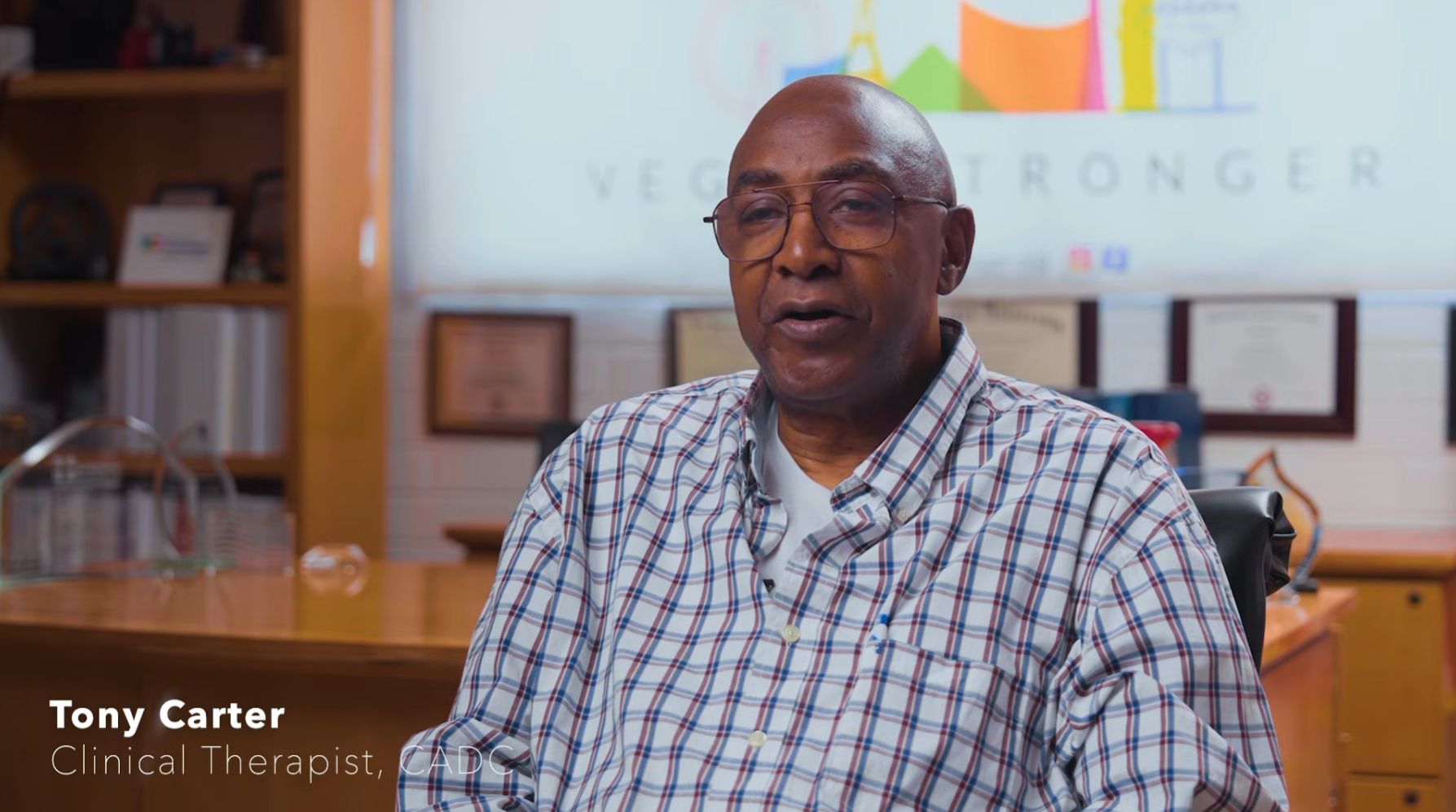

Expertise provided by David Marlon, Owner
You pick a morning, afternoon, or evening group, you show up three days a week for three hours, and a ride and a meal are already part of the plan. That is the shape of the IOP program at Vegas Stronger, and it was built that way on purpose. Most people who walk through the door are not asking about therapy first. They are asking whether they can do this and still keep a job, make a court date, see their kids, or have a place to sleep tonight.
This page explains how intensive outpatient treatment runs at 916 N. Main Street in downtown Las Vegas, NV. It covers who leads your group, what a week looks like, which services come with it, how rides and housing support work when you have nowhere steady to stay, where IOP fits between PHP and outpatient care, how medication fits in, and who IOP is not the right fit for. If you were hoping for telehealth, ask the team what is available, since this page focuses on in-person groups. On cost, Vegas Stronger accepts Medicaid. It also accepts Aetna, Blue Cross Blue Shield, Cigna, and UnitedHealthcare, but it is not in-network with those four plans. If you do not have Medicaid yet, a case manager can help you start enrollment.
If you are reading this for a family member, such as a son, a sister, or a partner, read it as their week. Every detail below describes what they would walk into.
What Is an Intensive Outpatient Program (IOP), and What Happens in a Group Day?
An IOP program, or intensive outpatient program, is a set schedule of group treatment that meets several days a week. It gives you real structure while you keep living at home or wherever you stay. At Vegas Stronger, every IOP group runs 3 hours, you attend 3 days a week, and a clinician leads each group. Groups meet in person, so ask the team if you have questions about telehealth.
SAMHSA’s clinical guide, TIP 47: Clinical Issues in Intensive Outpatient Treatment for Substance Use Disorders, describes intensive outpatient treatment as a level of care with more hours and more structure than standard outpatient counseling, so people can receive structured support without leaving their community. Here is a plain way to picture it. A weekly counseling session is like checking in with a coach once a week. IOP is closer to a part-time job you take on for your recovery, with set hours and people who expect you to show up, and you still go home at the end of the shift.
Inside the room, the work is trauma-informed and built on evidence-based care. Clinicians use skills from cognitive behavioral therapy (CBT) and dialectical behavior therapy (DBT), plus Seeking Safety, an approach designed to address substance use and trauma together without reliving the worst moments too early. Groups also use grounding, visualization, and somatic approaches, which are meant to help your body settle when your mind is racing, along with plain teaching about what substances do to your brain and body. You are fed during your IOP day, so hunger is not one more thing pulling your attention out of the room.
The clinician is not working alone. Vegas Stronger hand-picks its clinicians for their connection to the mission, and a separate team handles prior authorization, billing, and admissions so the clinicians can focus on being clinicians. Around each person in IOP, the team includes peer support specialists, case managers, community health workers, and the medical and psychiatric teams, so your services stay connected. Every client is assigned a peer support specialist and builds a separate peer plan with them. Peers work the lobby seven days a week, and they often learn things in a hallway conversation that a clinician might not hear in group. That information goes back to the same team, working toward the same treatment goals for the same person.
About 80 percent of the Vegas Stronger staff is in recovery, and the organization means recovery the way twelve-step fellowships define it: full abstinence from all mind-altering substances. In practice, the person leading your group, sitting with you in the lobby, or driving you home may well have been where you are sitting now, and may know what addiction does to a family.
What Does a Sample Week of IOP Look Like in Las Vegas, NV?
A week of IOP at Vegas Stronger is three group days you choose, each 3 hours long, plus personal trainer sessions three times a week and optional classes and services around them. Groups run in morning, afternoon, and evening blocks, seven days a week, so you can build your three days around the rest of your life, including work and family. Groups are held in person, so if you are counting on telehealth, ask the team during intake.
Here is how the pieces of a week fit together:
| Part of the week | What it involves at Vegas Stronger |
|---|---|
| IOP group | 3 hours per group, 3 days a week, in a morning, afternoon, or evening block, offered 7 days a week |
| Personal trainer | 3 sessions a week, with a fitness habit tailored to you |
| Meals | You are fed during IOP |
| Rides | Transportation to and from treatment |
| Entrepreneur class | Learning to manage spending and your financial life |
| Theater program | Role-playing, camaraderie, and practice seeing a situation from another person’s side |
| Therapeutic recovery yoga | Breathing, relaxing, and getting grounded in your body |
| Peer support, case management, psychiatric care | Woven around your group days as your plan calls for |
Two people can live very different weeks inside the same program. If you work days, evening groups after your shifts or on your days off may fit, and your team will work with you on a schedule that holds. If you are staying at a shelter and your days are wide open, morning groups plus trainer sessions and classes can fill hours that may have lacked structure. Vegas Stronger does not require you to change careers to be in treatment, and if you decide you want a different line of work, the team will help you with that too.
The extras are part of the design. The personal trainer builds a fitness habit around your body and your starting point, not a generic gym routine. The entrepreneur class deals with money, which is often one of the first things to fall apart and one of the hardest to rebuild. Many clients join the theater program for the role-playing, the camaraderie, and the insight that can come from playing someone else’s role. The yoga instructor has years of experience in therapeutic recovery yoga and focuses on breathing and grounding. None of these features promise a result. They exist because recovery takes up more of the week than three group sessions, and the hours in between matter.
How Do Rides and Housing Support Make IOP Work for People Without Stable Housing?
At Vegas Stronger, not having a stable place to sleep does not keep anyone out of IOP. Case management works out where you will sleep, housing partners provide the place, and the transportation team drives you there and back for your next group.
Here is how the end of a group day works if you have nowhere steady to go. Case managers have already worked out where you will sleep, usually through Vegas Stronger’s housing partners or other community partners who offer safe temporary housing. The transportation team takes you to a place with a bed and clean restrooms and schedules your pickup for the next day’s group. You do not have to figure out a bus route while you are in withdrawal or worn out from a hard session, because the ride is already booked.
The reason is simple: it is hard to focus on recovery when you are worried about where you will sleep or how you will get to treatment. David Marlon, CEO of Vegas Stronger, puts it this way: “integrated Behavioral Health Care only works if the client is present.” In the team’s experience, providing rides to and from treatment may help more people stay engaged. The transportation staff are each in recovery as well, and Marlon says they are the people clients often remember most.
To be clear about what Vegas Stronger is and is not, it is an outpatient treatment center only, offering PHP, IOP, and outpatient care. It does not provide residential treatment, detox, or sober living. What the housing partners and transportation team create together is a system that looks and feels a lot like residential treatment, with daily structure, a ride, a meal, and a team that knows where you are, while it stays outpatient.
The location helps too. The clinic sits in the Corridor of Hope, less than a mile’s walk from Fremont Street and between most of the downtown shelters, so many people already pass the building every day. The outreach team invites people onto the Vegas Stronger bus and brings them back to the main campus. If you call instead, staff will encourage you to come in by bus or a rideshare. Once you arrive, case management handles the practical pieces that often get in the way of treatment: getting identification, making sure you are enrolled in Medicaid, sorting out where you will sleep, coordinating other medical needs, figuring out what to do with a pet, and even finding shoes or clothes if you need them.
Marlon has worked in the Corridor of Hope for 10 years and has a firm view about the people he sees there. In his view, integrated behavioral health care is “the path to address our homelessness crisis.” Housing support at Vegas Stronger exists to help people stay engaged in treatment.
Where Does IOP Fit Between PHP and Outpatient Care?
IOP is the middle step in Vegas Stronger’s PHP to IOP to outpatient continuum. Many people start in PHP, which meets 5 or 6 days a week, move to IOP once they are stable, and later move to outpatient care for less frequent, deeper work.
PHP at Vegas Stronger focuses on the primary substance use disorder. It includes 5 or 6 days a week of intensive counseling and individual sessions, with case management, peer support, and psychiatric care. Some people begin there, while others start directly in IOP or outpatient care, based on what the same-day assessment shows. That assessment decides where you start.
The team steps you down from PHP to IOP when two things are true: you are stable, and your primary substance use disorder and mental health have been addressed. Stepping down does not mean you have finished. It means you need fewer hours of structure each week to stay on track, so you get back more of your time while keeping the same team and the same plan.
Trauma work follows a set order at Vegas Stronger, and the team holds to it. Many people want to dig into old pain in their first weeks, but the team usually encourages a “one step at a time” focus instead: get grounded, build social supports, and stop using the fentanyl, the alcohol, or whatever brought you in. That is why IOP leans on trauma-informed CBT, DBT, Seeking Safety, and somatic approaches, since these tools are intended to help you stay steady before you go deeper. Through IOP and case management, the team also works on home, work, and social supports.
More intensive trauma-focused treatments, like EMDR and exposure therapies, usually come later, often in outpatient care. They start only after you have a strong therapeutic alliance with your clinician and a track record in therapy. Then the work moves to childhood trauma, grief and loss, relationship problems, assault and sexual trauma, and PTSD, one layer at a time. Vegas Stronger treats co-occurring clients, people with both a substance use disorder and a mental health condition, in one integrated plan, and both are worked on together from day one.
Research has examined IOP as a level of care. A review of research on substance use intensive outpatient programs reported that, in the studies reviewed, IOP outcomes for some people were comparable to those of inpatient or residential treatment. That does not make IOP right for everyone, which is why level of care is assessed first. If someone needs detox before outpatient care can begin, case managers arrange the admission, drivers take them there, a release of information is requested so the team can stay in contact, and Vegas Stronger picks them up afterward to start PHP, IOP, or outpatient care.
How Does Medication Support Work Alongside IOP?
Medication-assisted treatment (MAT) is available alongside IOP at Vegas Stronger, inside an abstinence-based framework. The team decides the safe level of care first and then decides on medication. MAT is never used to keep someone in outpatient care when they need medically supervised withdrawal.
Every person who comes in for same-day access meets with a psychiatric prescriber after the clinical assessment. The prescriber completes a psychiatric evaluation and addresses MAT, and the first question is always the same: what is the safest level of care today? If your withdrawal risk is more than an outpatient setting can safely manage, you are referred to medically supervised detox right away. If uncomplicated withdrawal can be handled safely as an outpatient, MAT can start the same day, alongside counseling and close follow-up.
Vegas Stronger’s on-site psychiatric prescribers use a range of medications intended to ease withdrawal, reduce cravings, and help with sleep. For opioid use disorder, these include oral Suboxone or buprenorphine, Sublocade (a 30-day, slow-release injectable form of buprenorphine), oral naltrexone, and the Vivitrol injection. For alcohol use disorder, the team favors acamprosate and naltrexone because they do not alter your mind. Other medications are used when clinically appropriate, and each plan also addresses any underlying psychiatric condition.
Long-acting injectables are ordered whenever possible, especially for people without stable housing, because a medication you get once a month is harder to lose, forget, or have stolen than a daily pill. During intake, a medical assistant orders the injectables, arranges medication delivery, and completes blood draws and an observed chain of custody urinalysis, all before you leave for the day.
Because Vegas Stronger is abstinence-based, everyone using MAT is also working a program toward full abstinence. The team sees MAT as recovery medication that may lower cravings and overdose risk so you can take part in group, peer support, and the rest of the work. Decisions about continuing or tapering a medication are made person by person, not on a fixed timeline. That view comes from experience: the CEO and the medical director are both in long-term recovery themselves. On newer trends such as psychedelics, the team’s position is to wait for peer-reviewed, double-blind evidence before using them.
When it is a close call, the team refers to detox, and it handles the referral itself. Staff check your insurance and bed availability, call to arrange the admission, and drive you to a detox program in Las Vegas where they have long working relationships. Detox admission is often hard to arrange on your own, which is one reason the team suggests coming to Vegas Stronger first to get assessed.
The team also sees risks that public data may not show yet. Vegas Stronger staff report that methamphetamine overdoses among the people they serve are rising to levels similar to opioid overdoses, and that many people wrongly see meth as less risky than fentanyl. They also point out that benzodiazepine withdrawal can be more dangerous than many people expect. If you drink heavily every day or take benzodiazepines daily, do not stop on your own.
How Long Does IOP Last, and Who Is It Not For?
IOP at Vegas Stronger has no set end date. According to CEO David Marlon, the average client stays about 6 months, and many stay longer than a year. Your own length of stay depends on your plan and your progress.
People do not stay a long time because the program wants them to. They stay because, in his words, they have “significant mental behavioral physical and social rebuilding to do,” and he believes a full support system may help them manage that rebuilding. That is comprehensive support over months: group, medication, peers, case management, fitness, and a ride every day.
Marlon describes one man, with identifying details left out to protect his privacy, who connected right away with his psychiatrist, case manager, peer support specialist, fitness trainer, yoga instructor, and counselor, even while he was sure he could keep up some recreational drug use. He had multiple recurrences and multiple incarcerations between treatment episodes, and Marlon noticed he looked worse every time he came back, but he kept coming back anyway. According to Marlon, this one man is now abstinent from drugs and alcohol and working on what Marlon calls “the Long Road of rebuilding his life.” His experience is his own and is not a typical result.
If you have tried treatment before and it did not hold, that history does not count against you here. Many people’s recovery includes more than one attempt.
You should also know up front that IOP is not the right fit for everyone. Marlon estimates that about 1 percent of the homeless population the team sees is too developmentally delayed, too severely mentally ill, or too violent to take part safely in a group setting, and Vegas Stronger does not offer long-term residential care for people in that situation. For almost everyone else, including people with serious mental illness and co-occurring clients, the team’s experience is that same-day access and long treatment in a recovery oriented system of care may be helpful.
What Do People Usually Ask Before Starting an IOP Program?
Most questions about IOP at Vegas Stronger come down to schedule, cost, setbacks, and what the clinic does not provide. Here are direct answers.
Can I work while attending IOP?
Many people can. Vegas Stronger runs IOP groups in the morning, afternoon, and evening, seven days a week, and you attend three days of your choosing, so you have room to plan treatment around a job. Whether a specific schedule works with your employer depends on your hours, so bring your work schedule to intake and the team will help you find group times that fit. Vegas Stronger does not require anyone to change careers to be in treatment.
How much does IOP cost, and is insurance accepted?
Your cost depends on your coverage, so call to talk it through. Vegas Stronger accepts Medicaid. It also accepts Aetna, Blue Cross Blue Shield, Cigna, and UnitedHealthcare, though it is not in-network with those four plans. If you are not enrolled in Medicaid, case management can help you start. Under federal mental health and addiction parity rules, most health plans that cover substance use treatment cannot put tighter limits on it than on comparable medical care. Your plan still decides what you pay, so ask the admissions team to help you check your benefits. The team’s focus at intake is the right level of care, not the insurance card.
What is the difference between IOP and PHP?
PHP at Vegas Stronger meets 5 or 6 days a week and focuses on the primary substance use disorder with intensive counseling and individual sessions. IOP meets 3 days a week for 3-hour groups and usually serves as the step-down once you are stable. Both include case management, peer support, and psychiatric care, and the difference is how much structure you need each week.
What if I have a recurrence during IOP?
Come back. Vegas Stronger has no three strikes rule, and a return after a setback is welcome. Your care team will reassess your level of care, which may mean adjusting your plan, moving back to PHP for more structure, or arranging detox if withdrawal makes outpatient care unsafe. A recurrence is information for the team, not a sign that you are out.
Does Vegas Stronger offer detox or housing?
No. Vegas Stronger is outpatient only and does not provide detox, residential care, or sober living. If you need detox, case managers arrange the admission, drivers take you there, and the team picks you up afterward to begin outpatient care. For a place to sleep, case management works with housing partners and community partners, and the transportation team takes you there each night.
Do I need an appointment, or is there a waiting list?
You do not need an appointment, and there is no waiting list. Vegas Stronger offers same-day access at 916 N. Main Street in Las Vegas, NV, and the team takes calls 24/7. When you walk in, front desk staff help you sign a consent to treat and fill out screens, offer you something to eat or drink, and walk you to a therapist for your assessment. From there you meet a psychiatric prescriber, a peer support specialist, and a case manager, and before you leave, you will know which group to attend tomorrow and when.
Can You Start IOP in Las Vegas Today?
Yes. Vegas Stronger offers same-day access with no waiting list, and your first day ends with a group time, a ride, and a plan for where you will sleep. You do not need to have everything sorted out before you come in, because sorting it out is part of intake.
Here is one practical tip most people do not know. Bring whatever identification you have, and come even if you have none, because case management helps with ID and Medicaid enrollment. When the therapist and prescriber ask when you last drank or used, and how much, tell them the truth. That answer shapes how they keep you safe, and it does not decide whether you get help. If the honest answer means you need detox first, the team arranges it, drives you there, and picks you up afterward.
Call Vegas Stronger or walk in to 916 N. Main Street in downtown Las Vegas, NV for same-day access. A team member will talk through your schedule, check your insurance or help start Medicaid enrollment, and set up your first IOP group and ride.
Wondering if an IOP fits your life in Las Vegas?
It is common to worry that intensive outpatient treatment will be too much to juggle, or that you are not far enough along to deserve it. Talking it through with the team at Vegas Stronger can help you see how an IOP program might work around your schedule and support the recovery you are hoping for. When you are ready, call the office and take that first conversation at your own pace.
Individual experiences vary, and every treatment plan is built around the person receiving it.