Many families hope one decision will settle everything. They send their loved one to a 28-day rehab and hope the problem will be behind them when the program ends, while the other path, months of rebuilding health, housing, and work, sounds like too much to ask. If you are asking what is the difference between rehab and recovery, that choice is the heart of it. Many families Vegas Stronger works with come to see that it is not really a choice at all, because the short program is one piece and the rebuilding is the rest.
You may already be living in that gap. Your loved one finished something and came home, and a few weeks later you were back to watching their eyes, checking your wallet, and lying awake. You did what you were told to do, and it still did not hold. That does not mean your family failed or that your loved one is beyond help. It may mean the plan stopped right where much of the real work starts.
Vegas Stronger, a nonprofit outpatient recovery center in downtown Las Vegas, NV, is built around that longer timeline. It accepts Medicaid, Aetna, Blue Cross Blue Shield, Cigna, and UnitedHealthcare, so cost does not have to be the first wall you hit. This page explains what rehab covers, what recovery involves, which level of care may fit which stage, and how to get a same-day assessment so you are not guessing alone.
What is the difference between rehab and recovery?
Rehab is a set block of clinical treatment that starts and ends on a schedule. Recovery is the longer process of rebuilding a person’s mental, behavioral, physical, and social life, and it can continue long after the last group session.
SAMHSA’s guiding principles of recovery describe recovery as a process of change in which people improve their health and wellness and live self-directed lives. The word “process” matters, because a process does not end on day 28. It moves at the person’s pace, and it covers the parts of life a short stay may not reach: sleep, mood, family, money, housing, and a reason to get up in the morning.
Vegas Stronger describes itself as almost the antithesis of a 28-day rehab. Its average client stays about 6 months, and many stay longer than a year. They stay because they have significant mental, behavioral, physical, and social rebuilding to do, and Vegas Stronger’s view is that people may be better supported while they are still inside an encompassing support system.
As a family member, you can change the question you ask. Instead of “How fast can they finish?” ask “Who is with them in the months after the crisis passes?” A short program can address immediate danger, while recovery work continues beyond it, and that often involves a team that stays.
What is a recovery center, and how is it different from a rehab facility?
A recovery center treats substance use and mental health conditions, then keeps supporting the person while they rebuild housing, work, and daily structure. A rehab facility, the way most people use the word, focuses on a shorter treatment stay, often residential, with a fixed end date.
Vegas Stronger is an outpatient recovery center that offers partial hospitalization (PHP), intensive outpatient (IOP), and outpatient (OP) care, along with medication-assisted treatment (MAT). It is located at 916 N. Main Street in Las Vegas, NV, near the Corridor of Hope downtown, and it is a designated Clark County Coordinated Entry site, which ties it into the county’s homelessness services. Access is same-day, with no waiting list. Vegas Stronger does not provide detox, residential care, or sober living. When someone needs one of those first, the team helps them get there and then brings them back into outpatient care.
Knowing who outpatient care may fit helps you avoid a dangerous mistake. It may suit people whose withdrawal can be managed safely without round-the-clock medical watch, but it is not the right first stop for someone at risk of severe withdrawal. Suddenly stopping heavy daily drinking or long-term benzodiazepine use can be life-threatening, and anyone with a history of withdrawal seizures or delirium tremens needs medical supervision first. If you are not sure which group your loved one falls into, do not try to wait it out at home. A same-day assessment exists to answer exactly that question.
Vegas Stronger also treats substance use disorders and mental health conditions together in one treatment plan, because the two often occur together. If trauma, depression, or psychosis is contributing to the use, treating only the drinking or the fentanyl may leave underlying factors unaddressed. That is the integrated behavioral health care approach Vegas Stronger is built on.
Rehab vs recovery: which levels of care and supports fit which stage?
Each level of care matches a different stage, from medical safety to daily structure to long-term community support. Many people use more than one, and the order matters.
| Level of care | What it is for | Typical intensity | Who it tends to fit | At Vegas Stronger |
|---|---|---|---|---|
| Medical detox | Managing withdrawal safely under medical supervision | Round-the-clock monitoring, usually a short stay | People at risk of severe withdrawal from alcohol, benzodiazepines, or complicated opioid use | Not provided. The team arranges admission and transport, then picks the person up afterward |
| Residential or inpatient | Living on site in a supervised treatment setting | 24 hours a day | People who need a fully supervised setting | Not provided |
| Partial hospitalization (PHP) | Treating the primary substance use disorder and stabilizing mental health | 5 or 6 days a week of intensive counseling | People who are medically safe but need daily structure | Provided |
| Intensive outpatient (IOP) | Building skills and routine as daily life restarts | 3 days a week, 3 hours per group, with morning, afternoon, and evening groups 7 days a week | People stepping down from PHP or starting in a stable place | Provided, with meals and transportation |
| Outpatient (OP) | Ongoing therapy, including deeper trauma-focused work | Fewer sessions than IOP | People with a steady track record in treatment | Provided |
| Medication-assisted treatment (MAT) | Addressing withdrawal, cravings, and overdose risk | Runs alongside counseling | People with opioid or alcohol use disorder when clinically appropriate | Provided alongside outpatient care |
| Sober living | Substance-free housing while working and attending care | Daily living | People rebuilding stable housing | Not provided. Accessed through housing partners |
| Peer fellowships (AA, NA, SMART Recovery) | Free, ongoing community support | Meetings you choose | Anyone, at any stage | Separate from Vegas Stronger |
At Vegas Stronger, PHP is where much of the intensive early work happens. Clients attend 5 or 6 days a week of intensive counseling and individual sessions, backed by case management, peer support, and psychiatric care. The focus is the primary substance use disorder and working toward mental health that is steady enough to build on. The Vegas Stronger team steps a client down to IOP when they are stable and the primary substance use disorder has been addressed, not when a calendar says time is up.
IOP gives your loved one more freedom while keeping a firm structure. Groups meet 3 days a week for 3 hours each, and Vegas Stronger runs them 7 days a week in the morning, afternoon, and evening, so a person with a shift job or a shelter curfew can still attend. Clients are fed during IOP, and a transportation team drives them to and from. Some clients pair outpatient care with housing partners and those rides, which can feel similar to a residential setting, but Vegas Stronger is an outpatient center only.
The tradeoff between levels is simple: more hours mean more support and less room for the rest of life, while fewer hours mean more independence and more responsibility. Neither is better on its own. The right level is the one that matches where your loved one is today, and that answer may change over time.
What does recovery look like after the clinical program?
Recovery after the clinical program moves on three tracks at once: treatment, housing, and work. Each track steps forward a little at a time, and Vegas Stronger plans for all three from the first week.
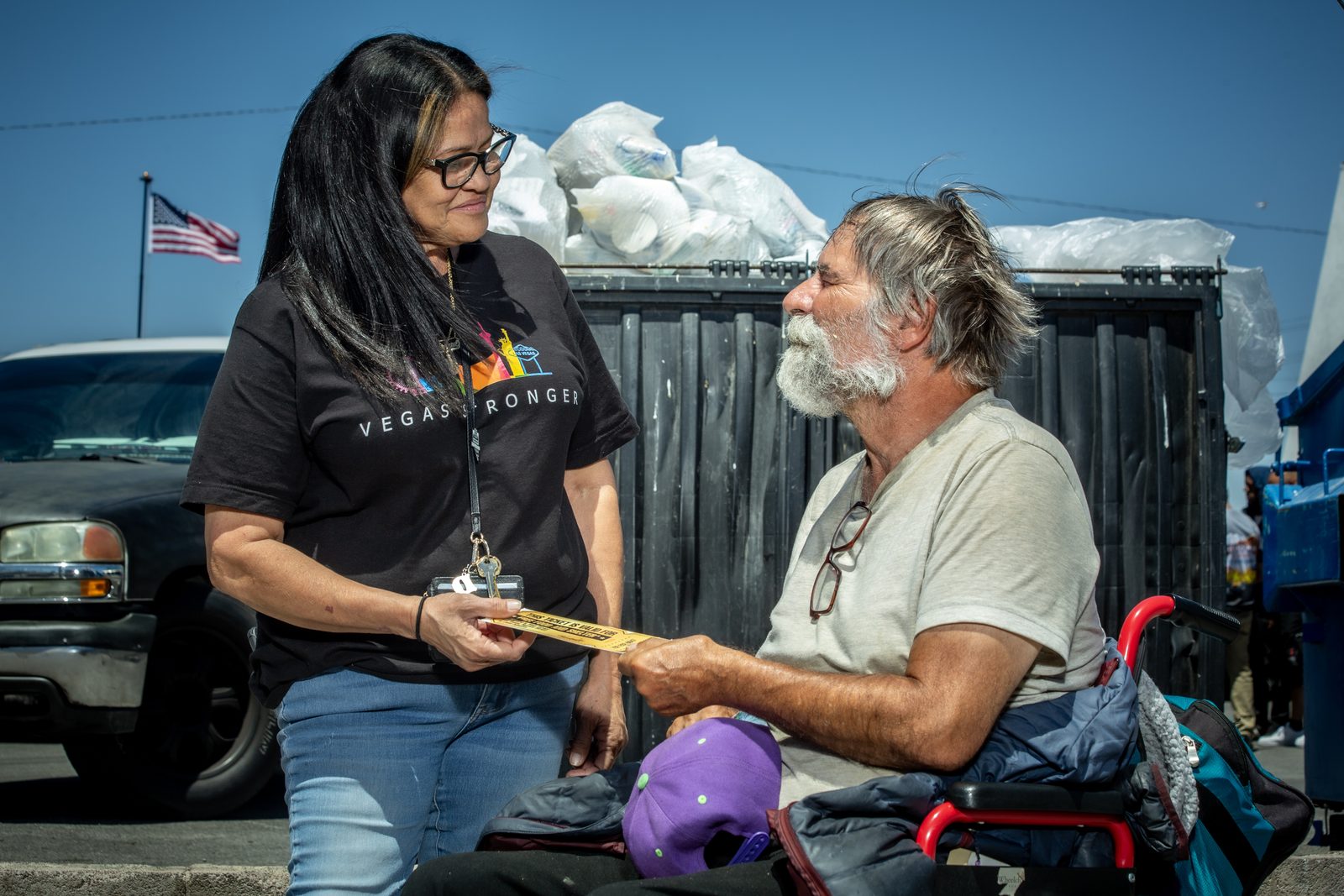
The treatment track usually runs PHP to IOP to outpatient, with clinicians, psychiatric prescribers, case managers, and peer support specialists working one treatment plan with the client. The housing track runs from congregate shelter to sober living to independent living, with sober living arranged through Vegas Stronger’s housing partners. Many people assume the answer to homelessness is a housing solution. Vegas Stronger CEO David Marlon, who has worked in the Corridor of Hope for 10 years, says that view overlooks something. When fentanyl dependence or psychosis is what pushed someone onto the street, housing alone does not address the primary condition.
The work track runs from a treatment-period job to gainful employment. As Marlon puts it, “It’s worth me mentioning that most of our clients are not ready for gainful employment after a week or a month of stabilizing a mental health condition or substance use disorder.” In his experience, about 60 days in treatment followed by around 6 months of “waking up, showering, and being on time” at a job like parking lot attendant or phone room work may help prepare some people, 8 to 12 months in, for a union job or a more livable wage. Clients are not required to change careers, but if they choose to, the Vegas Stronger team helps them through it.
The goal Vegas Stronger works toward is a person who is sober, housed, and employed, becomes self-supporting, rebuilds self-esteem, and works a program of recovery. Not every person reaches every part of that goal, and the timeline differs from person to person, which is one reason the program’s timeline runs long on purpose.
Why does recovery support go beyond therapy sessions?
Much of recovery happens outside the therapy room: in the lobby, on the ride home, at the gym, and in the hours between groups. Vegas Stronger surrounds clinical care with peer support, case management, fitness, and community programs so your loved one is not alone during those hours.
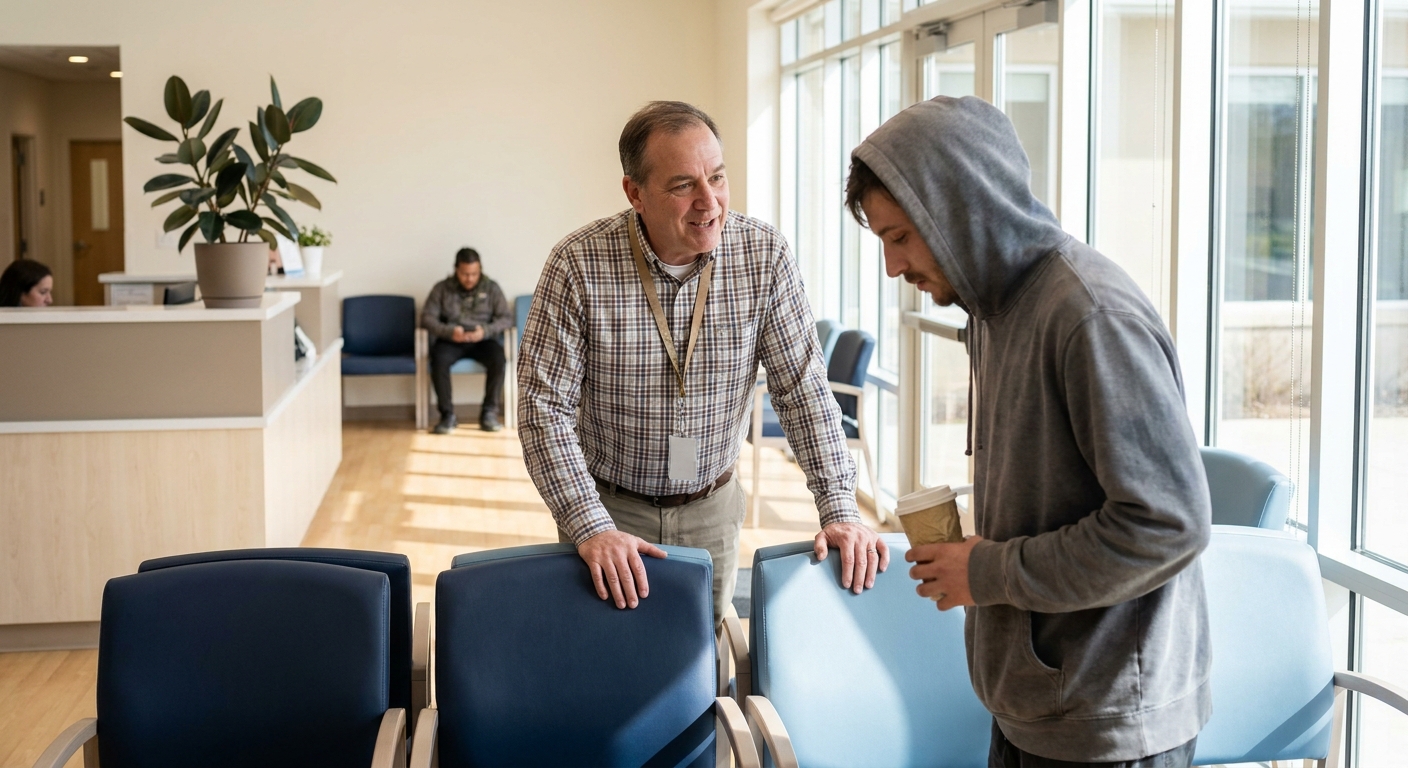
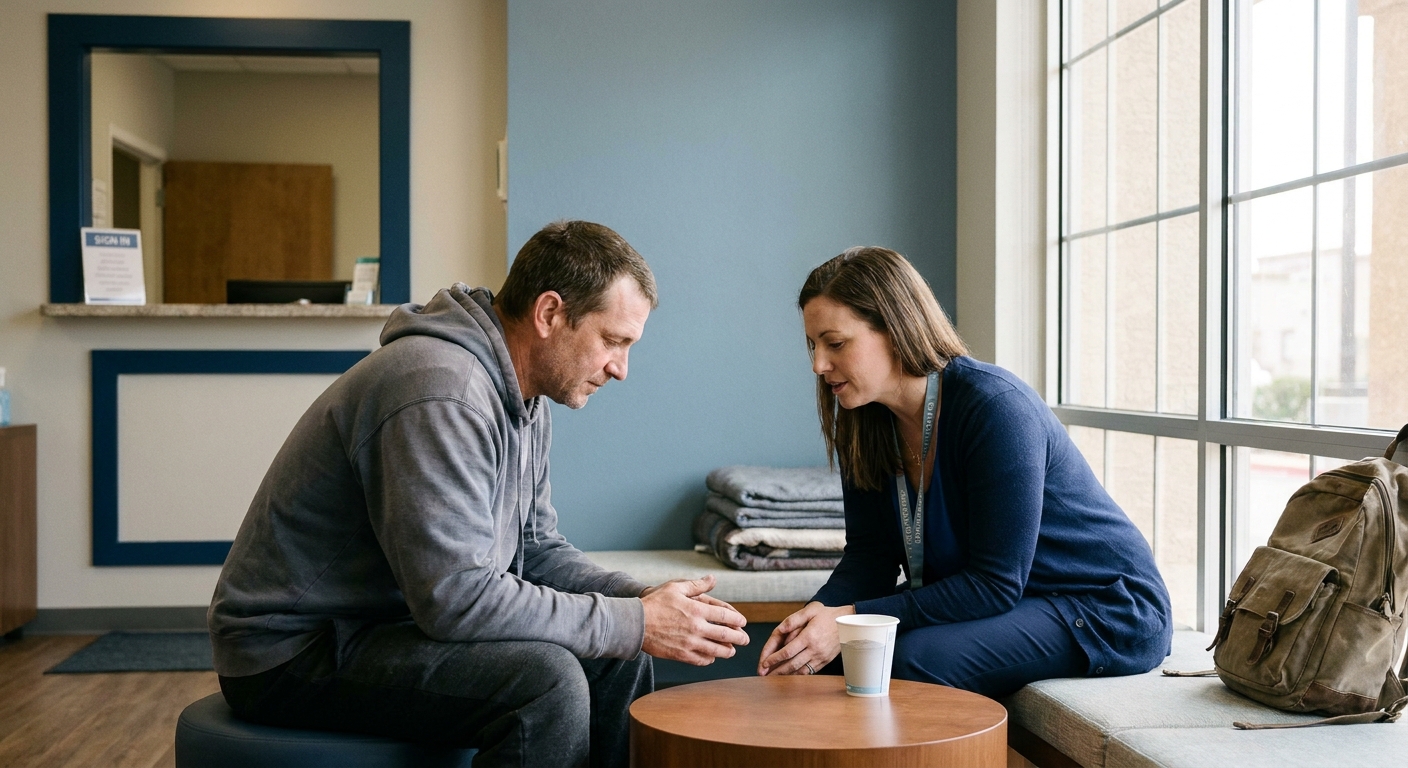
Every client at Vegas Stronger is assigned a Peer Recovery Support Specialist, and peers work the lobby and waiting room 7 days a week. They are often the first people your loved one meets. They point out the restroom, bring food or clothes, share some of their own story, and explain how the clinic works. Because peers sit on the same team as the psychiatrist, case managers, counselors, and fitness staff, what they learn goes into the same treatment plan. Vegas Stronger’s case managers start with immediate safety, since that carries the highest risk to life, then move to ID, Medicaid enrollment, and where the person will sleep. They also listen: if a client is fixated on getting their ID, they get the ID going.
IOP at Vegas Stronger adds more than groups. A personal trainer sees each client three times a week to build a fitness habit suited to that person. Many clients join an entrepreneur class to learn to manage spending and money, a theater program that uses role-playing to build insight and camaraderie, and therapeutic recovery yoga that helps people breathe, settle, and reconnect with their bodies. The drivers on the Vegas Stronger transportation team are in recovery themselves, and many clients remember them.
Behind that support is trauma-informed care drawing on evidence-based approaches. Vegas Stronger clinicians use CBT, DBT, Seeking Safety, and somatic approaches in PHP and IOP. EMDR and exposure therapies come later, once the substance use disorder and mental health are stable and a strong therapeutic alliance is in place. Early on, the emphasis is one step at a time: get grounded, build social supports, and stop the fentanyl before “peeling the layers of the trauma onion.” On the medication side, psychiatric prescribers use buprenorphine (Suboxone), Sublocade, oral naltrexone, Vivitrol, and acamprosate when they fit, and they order long-acting injectables whenever possible to reduce the effect of missed doses. Vegas Stronger is abstinence-based, so MAT is treated as a tool that supports the work toward abstinence, not a substitute for it.
If you are afraid of paying for a program that takes your money and sends your loved one back unchanged, that fear is reasonable. A useful question for any program is whether it has a plan for the parts of life a group session cannot address, and what you just read describes what that plan looks like in practice.
Is a return to use the end of recovery?
No. A return to use is a signal that the plan may need to change, not proof that recovery has failed or that your loved one has used up their chances.
NIDA describes addiction as a treatable, chronic condition and notes that relapse rates for substance use disorders, estimated at 40 to 60 percent, are similar to those for other chronic illnesses such as high blood pressure and asthma. When symptoms of those illnesses come back, doctors adjust the treatment instead of telling the patient to stop coming. The same thinking applies here.
Vegas Stronger has no three strikes rule. If someone has a recurrence, they can come back, and for some people it takes two, three, or 10 treatment episodes. The organization sees itself as “the last house on the block” for some of the most underserved people in Las Vegas, so closing the door is not an option it takes lightly. If you are worried that your loved one will refuse to go or will leave early, know that walking out does not end the relationship. The door stays open.
One client’s experience shows how this can play out, with identifying details withheld to protect privacy. A man came to Vegas Stronger talking a big game and sure he could keep some recreational drug use going. Even so, he connected right away with several members of the care team. He had multiple recurrences, and each time he returned he looked worse, but he kept coming back. Today he is abstinent from drugs and alcohol and doing the long work of rebuilding his life. The Vegas Stronger CEO describes him as a work in progress.
What support groups are available in Las Vegas?
Las Vegas has meetings from several free, widely known peer fellowships that anyone can attend at any stage of recovery. These groups add community support alongside clinical care:
- Alcoholics Anonymous (AA): a free fellowship built on the Twelve Steps for people who want to stop drinking. Find current Las Vegas meetings through the official AA meeting finder.
- Narcotics Anonymous (NA): a free Twelve Step fellowship for people recovering from drug use. Find current Las Vegas meetings through the official NA meeting search.
- SMART Recovery: free mutual-support meetings that use science-based self-management tools, offered in person and online. Find meetings through the official SMART Recovery meeting finder.
These fellowships are separate from Vegas Stronger’s clinical and peer services. A meeting does not replace a psychiatric evaluation, medication, or a treatment plan, and treatment does not replace the people your loved one may meet in a room full of others who have been there. Some people use them together. Meeting times and locations change often, so always check each group’s own directory rather than relying on an old flyer or a forum post.
If you are not sure where your loved one stands, start with clinical care and add meetings as they stabilize. You can learn more about the Vegas Stronger outpatient recovery program and how its peer support specialists help clients connect with fellowship meetings as part of a longer plan.
Are you allowed to talk to people in rehab?
Usually yes, but every program sets its own rules for phone calls, visits, and family updates. What staff can tell you depends on what your loved one agrees to share in writing.
Substance use treatment records are protected by strict privacy rules. Without your loved one’s signed consent, called a release of information, staff often cannot even confirm that the person is in care. That can feel like being shut out at the moment you are most afraid. It helps to see it another way: the consent belongs to your loved one, and asking them to sign it is a way of inviting you in while respecting their dignity.
At Vegas Stronger, when the team arranges a detox admission, it requests a release of information so it can stay in contact with the person through that stay, and staff share only what the person consents to share. For other questions about contact, ask directly. Good questions for any program include: When can we call? Are visits allowed, and when? Are there family sessions? How will updates be shared, and who do we contact if we are worried? A program that answers clearly is one you can work with.
Which should you choose: rehab first, recovery support first, or both?
For many people the answer is both, in the right order: medical detox first when withdrawal is risky, then structured outpatient care with long-term recovery support. This is where the question of what is the difference between rehab and recovery stops being abstract, because finishing a short program on its own may leave much of the rebuilding undone.
Vegas Stronger’s guiding question is simple: what is the safest level of care today? During the same-day assessment, the team looks at substance history, when the person last used and how much, past withdrawal, any seizures or delirium tremens, current medications, vital signs, and safety risks. It uses validated tools such as the CIWA-Ar for alcohol withdrawal and the COWS for opioid withdrawal. When it is a close call, the Vegas Stronger team refers to detox.
Choose medical detox first if your loved one drinks heavily every day, has a history of withdrawal seizures or delirium tremens, depends on high doses of benzodiazepines, or has serious medical or psychiatric instability. Vegas Stronger does not provide detox, but it handles the hard parts: the team checks insurance and availability, calls and arranges the admission, transports the person to one of the 6 detoxes in Las Vegas, requests a release of information, and picks the person up afterward to start PHP, IOP, or OP. Detox admission is often cumbersome, which is why coming in for an assessment first can save days.
Consider outpatient care with MAT right away if withdrawal is uncomplicated and can be managed safely outside a hospital. In that case, MAT can start the same day at Vegas Stronger alongside comprehensive behavioral treatment and close follow-up. Plan for long-term recovery support either way. Whichever path comes first, the months of step-down care, housing, and work are part of how a stabilized person builds a life beyond treatment.
On cost, Vegas Stronger accepts Aetna, Blue Cross Blue Shield, Cigna, UnitedHealthcare, and Medicaid. It is not in-network with those commercial plans, so ask your plan about out-of-network behavioral health benefits. Under the federal Mental Health Parity and Addiction Equity Act, plans that cover mental health and substance use care generally cannot limit it more strictly than medical care. If your loved one has no coverage, Vegas Stronger case managers help with Medicaid enrollment at intake. The admissions process is built around finding the right level of care, not around insurance.
How do I get started or contact a recovery center in Las Vegas?
Call Vegas Stronger or walk in, and your loved one can be assessed the same day with no waiting list. From there, the process follows a clear order:
- Call or come in. Vegas Stronger says it takes calls 24/7. If your loved one is downtown, they can take a bus, Uber, or Lyft to the clinic.
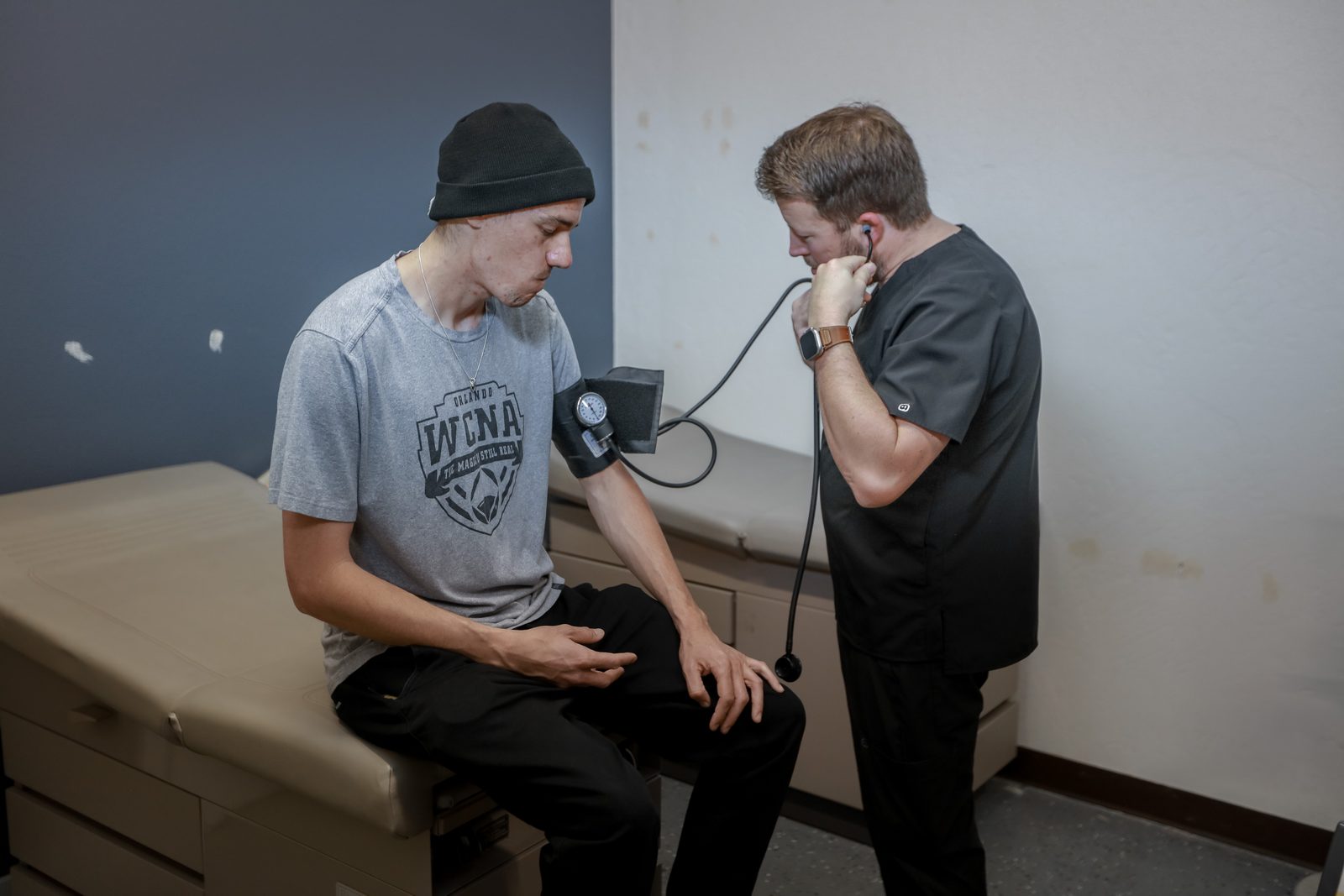
- Complete a same-day intake assessment. Front desk staff help your loved one sign a consent to treat, fill out screens, and get food or drink. A therapist completes a clinical assessment, and a psychiatric prescriber does an evaluation.
- Learn the safest level of care. The Vegas Stronger team uses tools like CIWA-Ar and COWS to decide whether outpatient care is safe today.
- Bridge to detox, or start MAT the same day. If detox is needed, the team arranges it, drives your loved one there, and picks them up afterward. If withdrawal is uncomplicated, medication can begin that day.
- Meet a case manager. Safety comes first, then ID, Medicaid enrollment, and a place to sleep.
- Get assigned a Peer Recovery Support Specialist. Every client gets one, and together they build a separate peer plan.
- Begin PHP, IOP, or OP. Staff tell your loved one which group to attend tomorrow and when, and the transportation team takes them to a place to sleep and schedules the next day’s pickup.
None of these steps require your loved one to show up with their life already in order. People arrive without ID, without a plan, and without a bed for the night, and the first visit at Vegas Stronger is designed for that.
You do not have to sort out every detail before the first call. Your job is to get your loved one assessed, and the Vegas Stronger team’s job is to identify the safest place to start and to stay with them through the months that follow.
Call Vegas Stronger today, or come to the Las Vegas, NV center for a same-day assessment with no waiting list, so a care team can help identify the safest level of care for you or your family member and start planning the next step. When you compare any program, including this one, do not stop at “How long is the stay?” Ask “What happens in month three, month six, and month nine?” That answer can help clarify what is the difference between rehab and recovery, because it tells you whether you are looking at a program that ends or a team that stays.
Individual experiences vary, and no treatment program can guarantee a specific outcome for any person. This page is for general information and is not medical advice. If you or your loved one is in immediate danger, call 911. For a mental health or substance use crisis, call or text 988.