If you show up today with no ID, no plan, and nowhere to sleep, your first minute at 916 N. Main Street in Las Vegas goes like this: someone offers you water or food, helps you sign a consent to treat, and walks you to a therapist. That is how same day addiction treatment Las Vegas works at Vegas Stronger. This guide walks you through the rest of that day in order, from the front desk to the ride that picks you up tomorrow morning. Then it covers the months of outpatient care that come after.
You may have tried before. Maybe a place put you on a waiting list, told you to call back when your insurance cleared, or said you had to be sober before they could talk to you. If you are bracing to be turned away again, that fear makes sense. Vegas Stronger offers same-day access with no waiting list, and the whole first day is built around one idea: people should leave with a plan for their next step.
If you are reading this for a son, a daughter, a husband, or a parent, you are probably exhausted. You may be afraid that one more failed attempt will be the one that costs them everything, and you may be wondering whether any place will actually help or just take your money. Everything below applies to the person you love, and you can call on their behalf.
Here is the honest version of “same day.” It means a same-day assessment and a same-day start in outpatient care. It does not mean an instant bed in a facility, because Vegas Stronger is an outpatient treatment center. The goal is for each person to leave day one with a next step.
What Do You Need Before You Come for Same Day Addiction Treatment in Las Vegas?
You need almost nothing. You do not have to be sober, carry an ID, or have your insurance figured out before you walk into Vegas Stronger, and there is no waiting list to get on first. The team takes calls 24/7 and can help you set up an assessment if you call before you come.
Here is the short list of what helps, in order of importance:
- You, as you are today. Sober or not, tired or not. Staff will check your withdrawal risk, so you do not need to stop using before you arrive. Do not try to quit alcohol or benzodiazepines cold on your own to “get ready.” That can be dangerous, and the team would rather assess you as you are.
- The truth about your last use. Be ready to say when you last used, how much, and whether you have ever had a seizure or delirium tremens (DTs) during withdrawal. These facts help decide whether you can start medication today or need detox first.
- Any medications you take now. Bring the bottles if you have them. If you do not, tell staff what you remember.
- Any ID, insurance card, or Medicaid card you have. If you have none, that is fine. Case management helps with identification and Medicaid enrollment as part of your first day.
- A way to get here, or a phone to call. If you call in, staff will usually suggest a bus, Uber, or Lyft to the clinic.
About insurance: Vegas Stronger accepts Aetna, Blue Cross Blue Shield, Cigna, UnitedHealthcare, and Medicaid. The admissions process is about finding the right level of care for you, not about insurance. In the team’s own words, they are “hung up on helping people,” not on paperwork. If you do have a health plan, the federal Mental Health Parity and Addiction Equity Act generally requires plans that offer mental health and substance use benefits to cover them on terms no more restrictive than medical and surgical benefits.
If you have no insurance and no money, where can you get free or low-cost help in Las Vegas?
- Walk in to Vegas Stronger anyway. Admissions is about your level of care, and case management works on Medicaid enrollment and replacing your ID on day one. Vegas Stronger accepts Medicaid.
- Nevada Medicaid. Many adults with low incomes in Nevada qualify, and you do not have to figure out the forms alone.
- Community health centers. Federally funded health centers charge on a sliding scale based on what you earn, and many offer behavioral health care.
- The 988 Suicide and Crisis Lifeline. Call or text 988 any time if you are thinking about hurting yourself. It is free.
- Free harm reduction supplies for clients. Vegas Stronger gives every client Narcan, plus fentanyl and xylazine test strips.
Once you know what to bring, the day itself moves step by step.
Step 1: How Do You Arrive or Call, and What Happens at the Front Desk?
You either walk in to 916 N. Main Street or call Vegas Stronger’s 24/7 line. Within the first few minutes, the front desk offers you food or a drink, helps you sign a consent to treat, and helps you fill out a few short screens before walking you to a therapist.
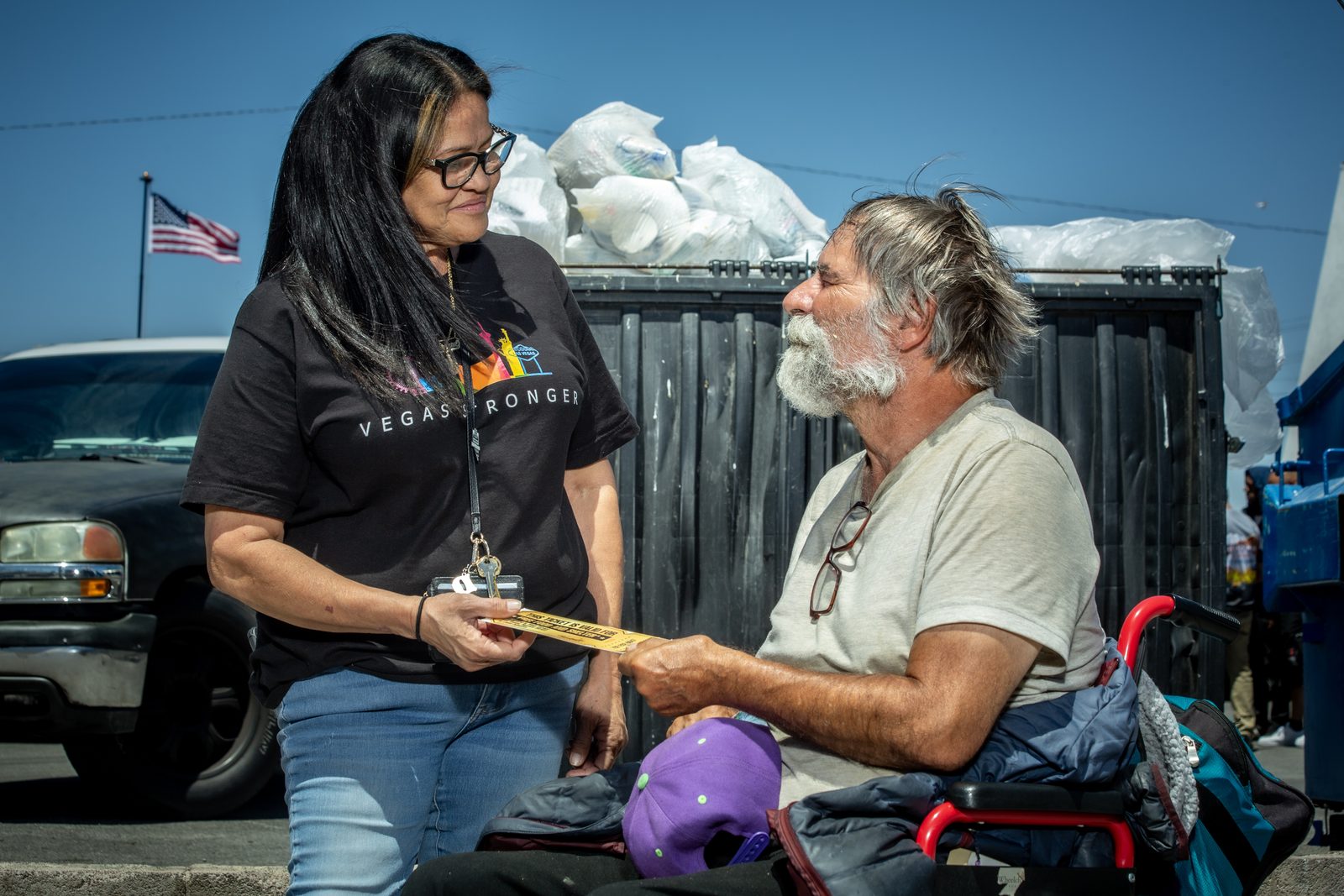
The clinic sits in downtown Las Vegas, less than a mile’s walk from Fremont Street, and it sits between most of the downtown shelters. If you are walking from Fremont to a shelter tonight, you will pass right by the front door. If you call instead, the team will help you find the fastest way in by bus, Uber, or Lyft. If Vegas Stronger’s outreach team meets you downtown, they will usually offer you a seat on the Vegas Stronger bus back to the main campus. The drivers on the transportation team are each in recovery themselves, and clients often mention them.
When you walk in, you will likely meet a peer support specialist before you even reach a clinician. Peer specialists work the lobby and waiting room seven days a week. They handle the small, urgent things first: where the restroom is, something to eat, a fresh shirt if you need one. Then they talk with you. Often they share part of their own story and explain how the clinic works, so you know what is coming instead of sitting there wondering.
Case management at Vegas Stronger is closely connected with social services agencies in Las Vegas, so the same building where you start treatment can also start the work on housing and other basic needs. What Step 1 is designed to do: get you inside, offer you something to eat or drink, complete your consent and screens, and have someone walk you to the next room.
Step 2: What Happens in the Clinical Assessment?
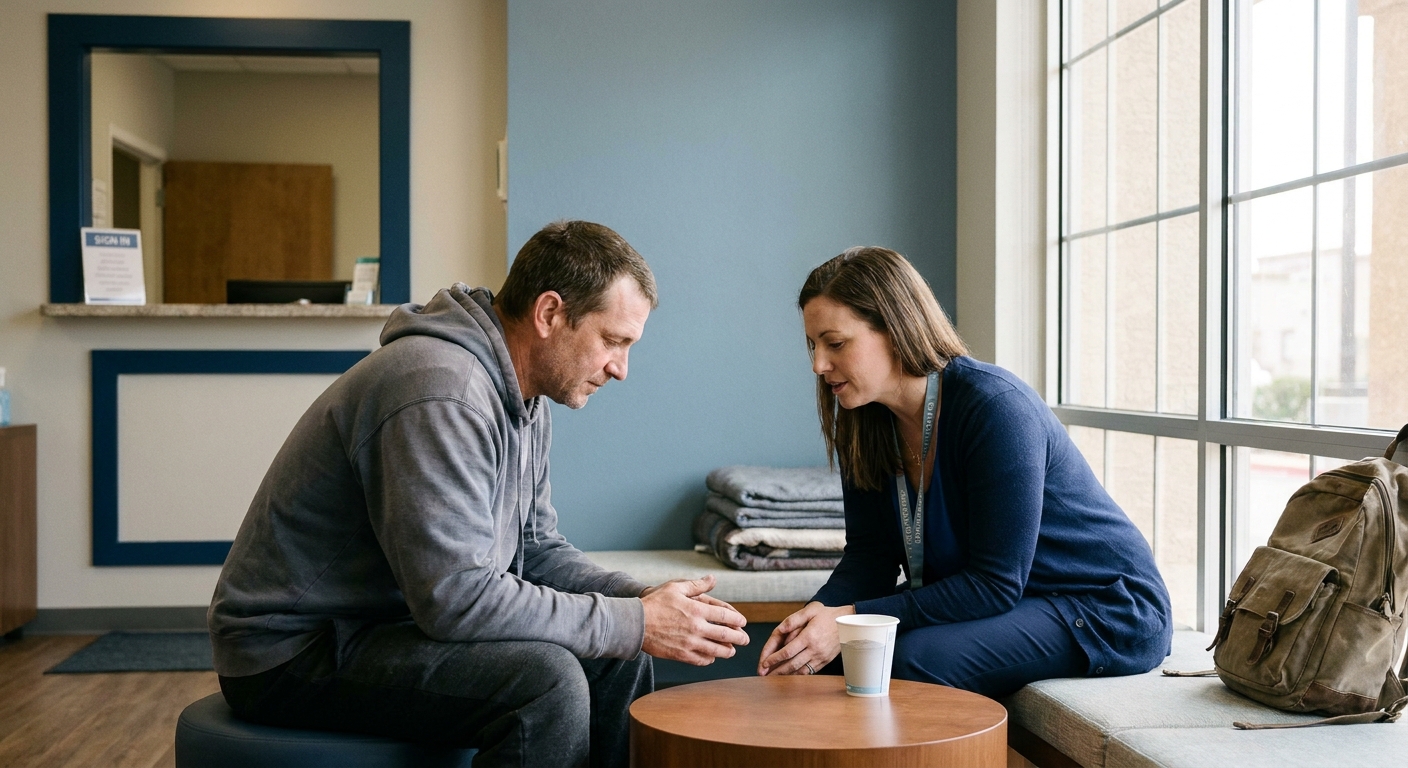
A therapist sits down with you for a conversation, not a test, and uses what you share to start your treatment plan. The main goal is to match you to the right level of care, whether that is partial hospitalization (PHP), intensive outpatient (IOP), or outpatient (OP).
The therapist will ask about your substance use history: what you used last and when, how much, and what happened the last times you tried to stop. They will ask about seizures, DTs, current medications, your medical history, and your mental health history. They will check vital signs, do a mental status exam, and ask about suicide and violence risk, not to judge you but to keep you safe tonight. They will also ask about the parts of your life that make recovery easier or harder, like who you have in your corner and where you have been sleeping.
You do not have to tell your whole life story today. Vegas Stronger uses a trauma-informed approach, which means nobody will push you to dig into your worst memories in your first hour. Many people who walk in are living with a substance use disorder and a mental health condition at the same time, such as depression, anxiety, PTSD, or a more serious psychiatric illness. Vegas Stronger addresses both the substance use and the underlying mental health condition in one integrated plan, so you are not bounced between two offices that never talk to each other.
What Step 2 is designed to do: produce a draft treatment plan, a recommended level of care, and the information the next team member needs to decide whether you can safely start medication today.
Step 3: Is Detox Needed First? How Level of Care Is Decided
It depends on how risky your withdrawal is. If your withdrawal is uncomplicated and can be managed safely as an outpatient, medication-assisted treatment (MAT) can start the same day.
At Vegas Stronger, the right level of care comes before the treatment method. When it is a close call, they send you to detox. That rule exists for your safety, and it is one of the most important things the first day is built around.
To make that call, staff use standard withdrawal scales. For alcohol, they use the CIWA-Ar (Clinical Institute Withdrawal Assessment for Alcohol, Revised). For opioids, they use the COWS (Clinical Opiate Withdrawal Scale). If you drink heavily, you are generally routed to detox if your scores are moderate to severe, or if you have had DTs, withdrawal seizures, a serious medical illness, severe psychiatric instability, or no safe place where someone can watch over you. Benzodiazepine withdrawal is treated as high-risk across the board, and if you take high doses or have any seizure risk, you are generally referred to supervised detox. Uncomplicated opioid withdrawal is often a fit for same-day outpatient MAT.
Vegas Stronger CEO David Marlon has watched the local picture shift for years. He points out that opioid overdoses in Nevada have not dropped the way they have nationally, that methamphetamine overdoses are rising to levels similar to opioids, and that too many people underestimate meth compared to fentanyl. He also warns that benzodiazepines are more dangerous to withdraw from than most people realize, and they are still widely prescribed and misused. That is why the team asks so many careful questions before anyone writes a prescription.
When detox comes first and who arranges it
If you need detox, you do not get handed a phone number and a “good luck.” Vegas Stronger’s staff check your insurance and bed availability, call and arrange your admission, and their drivers take you to one of the six detox programs in Las Vegas. Former Vegas Stronger staff now work at all six, which can help when a detox admission gets complicated, and it often does.
Before you go, you will be asked to sign a release of information so the team can stay in contact with the detox staff while you are there. When your detox stay ends, Vegas Stronger picks you up and brings you back to start PHP, IOP, or OP. This is why the team tells people it is often better to come to Vegas Stronger first, even if you think you need detox. The detox admission and your next step can be lined up at the same time. You can read more about what the first 72 hours of detox look like and what comes next.
What Step 3 is designed to do: give you a clear answer on whether you start outpatient care today or go to detox first, and, if detox, a ride, an admission, and a pickup planned.
Step 4: What Do the Psychiatric Prescriber and Medical Assistant Do?
The psychiatric prescriber does a psychiatric evaluation and talks with you about medication-assisted treatment. The medical assistant then handles the practical medical tasks: long-acting injectable orders, medication delivery, blood draws, and an observed chain-of-custody urinalysis.
The prescriber looks at the whole picture, including your substance use, any mental health conditions, your sleep, and your cravings. For opioid use disorder, options can include oral Suboxone or buprenorphine, Sublocade (a 30-day, slow-release form of buprenorphine), oral naltrexone, and Vivitrol, which is an injectable form of naltrexone. For alcohol use disorder, after any needed detox, options can include naltrexone, acamprosate, and in selected cases disulfiram. The prescriber may also use other medications for withdrawal symptoms, sleep, or an underlying psychiatric condition. Every person is different, and so is every medication decision, so nobody can promise how a medication will work for you.
Vegas Stronger is abstinence-based. MAT is used as recovery medication, a tool intended to help reduce withdrawal, cravings, and overdose risk so you can show up for counseling and rebuild your life. Every client works toward abstinence from intoxicating substances, and decisions about continuing or tapering medication are made with you, based on your progress and goals, not on a fixed calendar.
The medical assistant orders long-acting injectables whenever possible to reduce problems with taking medication consistently. When you do not have a stable place to keep pills, a monthly injection can mean one less thing to lose or forget. The medical assistant also arranges medication delivery, draws blood, and does an observed chain-of-custody urinalysis, which gives the team a more accurate picture of what is in your system. Every client also receives Narcan and fentanyl and xylazine test strips.
Do walk-in or same-day options exist for medication-based treatment such as methadone? In the United States, methadone for opioid use disorder can only be dispensed through federally certified opioid treatment programs. Vegas Stronger does not list methadone among its medications, but it can often start buprenorphine the same day when withdrawal is uncomplicated. For more on how medication options compare, see the Vegas Stronger opioid treatment program guide.
Medication is only one part of day one. The next part is about the person behind the chart.
Step 5: How Do Peer Support and Case Management Cover Basic Needs Today?
Every Vegas Stronger client is assigned a peer support specialist who builds a separate peer plan with you. Then a case manager works on the things that can derail recovery before it starts: your ID, Medicaid enrollment, where you will sleep tonight, other medical problems, your pets, and shoes or clothes if you need them.
Your peer support specialist brings lived experience of recovery, and their job is to connect with you as a person. The peer plan is separate from your clinical plan, and it focuses on what life in recovery looks like day to day. Peer specialists sit on the same team as your counselor, case manager, and prescriber. They often hear things a client will not say in a clinical office, and they share what matters with the rest of the team. Same team, same client, same treatment goals.
Case managers think about safety first. If something puts your life at risk tonight, that gets handled before anything else. But the team also listens, and if replacing your ID is the thing keeping you up at night, they will get your ID process going. If you have a dog, you do not have to choose between your pet and your recovery, because case management helps work that out too. They will also coordinate other medical issues you may have been putting off.
Vegas Stronger does not run its own sober living. Instead, many clients use the clinic’s housing partners, combined with the transportation team, to build a week with structure from morning to night that can resemble the routine of residential care. What Step 5 is designed to do: connect you with a peer specialist who knows your name, a case manager working on your ID and Medicaid, and a place to sleep tonight.
Step 6: What Is the Plan for Tonight and Tomorrow Morning?
Before you leave, staff tell you which group to attend tomorrow and what time it starts. Then the transportation team drives you to a place to sleep with clean restrooms and schedules your pickup for the morning.
This last step is not an afterthought. Plenty of people get assessed somewhere, get a referral slip, and never make it to the second appointment because they had no ride, no food, and no idea where to go. Vegas Stronger built transportation and meals into care because, as the team puts it, “integrated Behavioral Health Care only works if the client is present.” A ride to group is part of the treatment.
By the end of day one, here is what the process is designed to offer, though every person’s day looks a little different:
- A clinical assessment and the start of a treatment plan.
- A level-of-care decision, and either a same-day outpatient start or a detox admission with a pickup arranged.
- A psychiatric evaluation and, if it is safe and right for you, medication.
- A peer support specialist, a case manager, and work begun on ID, Medicaid, and basic needs.
- A place to sleep tonight, a group time tomorrow, and a scheduled ride.
That is a long day, and you may feel worn out by the end of it, which is normal. You do not have to feel ready for everything that comes after. You only have to get in the van tomorrow morning.
What Happens After Day One: PHP, IOP, and Outpatient Over Months?
Day one starts a continuum of care that can run for months, not weeks. Many people move from PHP to IOP to outpatient as they become more stable, and the pace is set by how you are doing, not by a calendar.
Vegas Stronger is almost the antithesis of a 28-day rehab. The average client stays about six months, and some stay for over a year, because they have real mental, physical, and social rebuilding to do. In PHP, you get five or six days a week of intensive counseling with individual sessions, backed by case management, peer support, and psychiatric care. In IOP, groups meet three days a week for three hours per group, and they run seven days a week in morning, afternoon, and evening tracks, so you can fit care around work or housing. IOP includes meals and transportation to and from the clinic. A personal trainer sees each IOP client three times a week to build a fitness habit. There is also recovery yoga, an entrepreneur class where people learn to manage money, and a theater program where role-playing helps people practice new ways of handling hard moments. Outpatient care continues the work at a lighter pace once you are steadier.
Trauma work is paced on purpose. In PHP and IOP, clinicians use cognitive behavioral therapy (CBT), dialectical behavior therapy (DBT), Seeking Safety, and somatic approaches that focus on grounding and body awareness. Deeper trauma-focused work like EMDR and exposure therapies comes later, only after your substance use and mental health are stable and you have built real trust with your therapist. If you want to dig into old wounds in week one, the team will usually encourage you to take it one step at a time: get grounded, get support, work on stopping the fentanyl or the drinking, and then start peeling back the layers. The National Institute on Drug Abuse keeps an overview of evidence-based treatment approaches if you want to read more about the research behind behavioral therapies and medication.
Can you do rehab as an outpatient while living at home? Yes. Outpatient care, including PHP, IOP, and OP at Vegas Stronger, is built for people who sleep at home or with a housing partner and come in for treatment during the day or evening.
What is the difference between inpatient and outpatient care?
| Level of care | Where you sleep | Typical schedule | Offered at Vegas Stronger? |
|---|---|---|---|
| Medically supervised detox | At the detox program, with 24-hour medical monitoring | A short stay focused on getting through withdrawal safely | No. The team arranges admission at one of six Las Vegas detox programs, transports you, and picks you up after |
| Residential or inpatient | On site, around the clock | You live at the facility for the length of the program | No |
| Partial hospitalization (PHP) | At home or with a housing partner | Five or six days a week of intensive counseling, individual sessions, case management, peer support, and psychiatric care | Yes |
| Intensive outpatient (IOP) | At home or with a housing partner | Three days a week, three hours per group, with morning, afternoon, and evening tracks seven days a week | Yes |
| Outpatient (OP) | At home or with a housing partner | Regular sessions at a lighter pace as you get more stable | Yes |
Many Vegas Stronger clients pair outpatient care with a housing partner and daily rides, which can give the week a lot of structure. Even so, Vegas Stronger is only an outpatient treatment center.
Can You Come Back After a Setback? Honest Limits and Returning to Care
Yes. Vegas Stronger does not have a three-strikes rule, and coming back after a recurrence is expected, not punished.
Marlon tells the story of one man he calls “the bicycle guy.” Vegas Stronger shares this account with names and identifying details left out to protect his privacy, and it is one person’s experience, not a typical one. He came in talking a big game and connected right away with the whole team: the psychiatrist, the case manager, peer support, the fitness trainer, the yoga instructor, his counselor, and Marlon himself. He was sure he could keep some recreational drug use going. He had multiple recurrences and multiple incarcerations between treatment episodes, and each time he came back he looked worse. But he kept coming back. Marlon says that today this man is abstinent and working on rebuilding his life. “I wouldn’t call him a success story today but I would call him a work in progress.”
That is what “we don’t have a three strikes rule” means in practice. The National Institute on Drug Abuse makes a similar point: a relapse does not necessarily mean treatment failed, it may mean treatment needs to be restarted or adjusted. If you slip, call or walk back in.
Now the honest limits. Vegas Stronger does not provide detox, residential care, or sober living. It also does not offer long-term residential care for people with severe psychosis or violent behavior. A small number of people, which Marlon puts at close to 1% of the homeless population he works with, are too ill or too violent to take part safely in group treatment, and they need a different kind of care than an outpatient clinic can give.
What Else Do People Ask Before Their First Day?
These are the questions people and their families ask most often before they walk in.
Can I get into addiction treatment in Las Vegas today?
Vegas Stronger offers same-day intake with no waiting list. That usually means a same-day assessment and an outpatient start in PHP, IOP, or OP, not an instant bed in a facility. If you need detox first, the team arranges it the same day.
Do I need ID or insurance to start treatment?
No. Case management helps you replace your ID and enroll in Medicaid. Vegas Stronger accepts Aetna, Blue Cross Blue Shield, Cigna, UnitedHealthcare, and Medicaid, and staff will explain how your plan fits. Admissions focuses on the right level of care, not your insurance card.
Do I have to be sober to walk in?
No. Staff screen your withdrawal risk using tools like the CIWA-Ar for alcohol and the COWS for opioids, then decide with you whether MAT can start today or detox should come first. Please do not stop heavy alcohol or benzodiazepine use on your own before coming in.
Does Vegas Stronger provide detox?
No. Vegas Stronger is outpatient only. If you need detox, the team checks availability, arranges your admission at one of six Las Vegas detox programs, drives you there, and picks you up afterward to start PHP, IOP, or OP.
Where will I sleep tonight?
Case management and the transportation team arrange a place for you to sleep with clean restrooms and schedule your ride back tomorrow. Vegas Stronger has no sober living of its own, but it works with housing partners.
What if my loved one refuses to go?
That fear is real, and nobody at Vegas Stronger will pretend you can force an adult into treatment. Everyone has agency. What the team can do is leave the door wide open. Marlon remembers a woman he met on the street who was living with mental illness and using opioids and methamphetamine. He asked her if it wasn’t time to get well, handed her a card, and walked away to let her sit with it. On her own terms, she walked in. Her experience included medication and counseling for her mental health, and more than a year in a sober living home. Marlon says she now does outreach herself. Her story is hers alone, not a promise, but it shows why the team keeps making the offer.
What if I relapse or leave treatment early?
There is no three-strikes rule. Returning to care is expected, and the door stays open. No one can promise an outcome, but you will not be shut out for having a hard time.
What Should You Do Right Now?
Call Vegas Stronger’s 24/7 line or walk in to 916 N. Main Street, Las Vegas, NV, today to start a same-day assessment. You do not need to be sober, and you do not need to bring an ID or insurance.
If you are reading this for someone you love, the same door is open to them, and you can call the line on their behalf to ask how to get them in. Families who search for same day addiction treatment Las Vegas are usually worn down from waiting lists and callbacks, and the point of this clinic is that today counts.
One thing can help the first day move more smoothly: before talking to anyone, figure out when the last use was, how much, and whether there has ever been a seizure or DTs while coming off alcohol or pills. Say it out loud at the front desk or on the phone. That single answer helps decide whether medication and outpatient care start today or a ride to detox comes first, and either way, the team at Vegas Stronger works to have tomorrow’s plan in hand before anyone leaves the building.
You Don’t Have to Have It All Figured Out Today
If you’ve been telling yourself you need to be more ready before you reach out, know that the first day at Vegas Stronger in Las Vegas, NV is built for people exactly where you are right now. Same day treatment starts with a conversation, not a commitment to anything you’re unsure about. When you’re ready, call the office and let someone walk you through what happens next.
Individual experiences and outcomes vary.